
Engineering Explained
Deep C Subsea Boulder Grab
A breakdown of the design and fuctionality.
Removal and relocation of subsea boulders
Clearance of subsea debris and obstructions
Recovery and relocation of seabed sediments
Seabed preparation for subsea installation
CAPACITY
Multiple configurations
Up to 4 m³ grab volume
SYSTEM DESIGN
Hydraulically actuated clamshell system
Reinforced load frame with heavy-duty pivots
Topside HPU or ROV hot-stab hydraulic supply
OPERATIONAL ADVANTAGES
Stable capture of irregular seabed material
Balanced force distribution during closure
Reliable lifting in dynamic offshore conditions
The Challenge of Subsea Boulder Removal
Subsea boulder and debris removal are fundamentally a force-control problem. Operators must capture irregular, high-mass objects from unpredictable seabed terrain while managing vessel motion, hydrodynamic drag, and limited visibility.
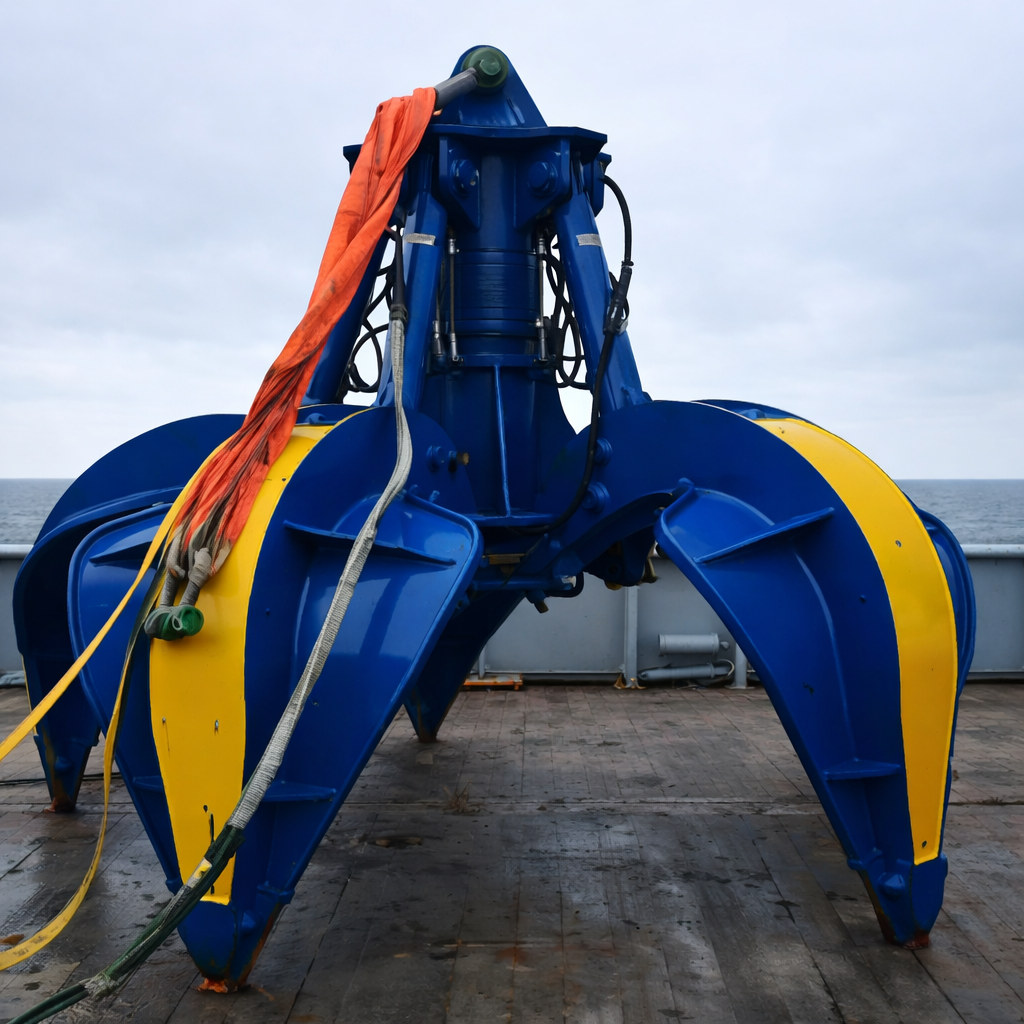
The Deep C Subsea Boulder Grab is engineered specifically for this environment, with volumetric options up to 4 m³ to accommodate varying project scales and lifting capacities.
Rather than functioning as a conventional crane attachment, the system is a hydraulically actuated subsea handling tool designed to convert controlled hydraulic energy into stable mechanical capture and predictable lifting performance.
System Configuration and Size Range
The Deep C Boulder Grab is available in multiple volumetric configurations, scaling up to 4 m³ capacity. While the overall dimensions, mass, and lifting interface vary between models, the underlying engineering architecture remains consistent across the range.
Increasing volumetric capacity affects three primary parameters:
① Structural reinforcement requirements in the main frame.
② Hydraulic force output is needed for effective closing under load.
③ Lifting demand on the deployment crane or winch system.
The largest 4 m³ configuration is optimized for high-volume removal campaigns, where reducing cycle count directly improves vessel efficiency. Smaller configurations provide improved maneuverability and reduced lifting requirements for constrained or precision operations.
| Technical Specifications | |||
| Dimensions and interface | 0.5 m³ | 2.3 m³ | 4.0 m³ |
Structural Design and Load Path Management
Hydraulic Actuation and Force Transmission
Related Equipment

Visiting address:
Headquarters:
Verkstedveien 1D
6517 Kristiansund N, Norway
Stavanger Office:
Kvernevik Ring 177, Entrance B
4048 Hafrsfjord, Norway
© 2026 Deep C Solutions AS | All Rights Reserved | Code of Conduct (PDF) | Privacy Policy | Substance & Addiction Policy (PDF) | HSEQ, Sustainability & CSR Policy (PDF) | Data Protection Policy: NO / ENG (PDF)